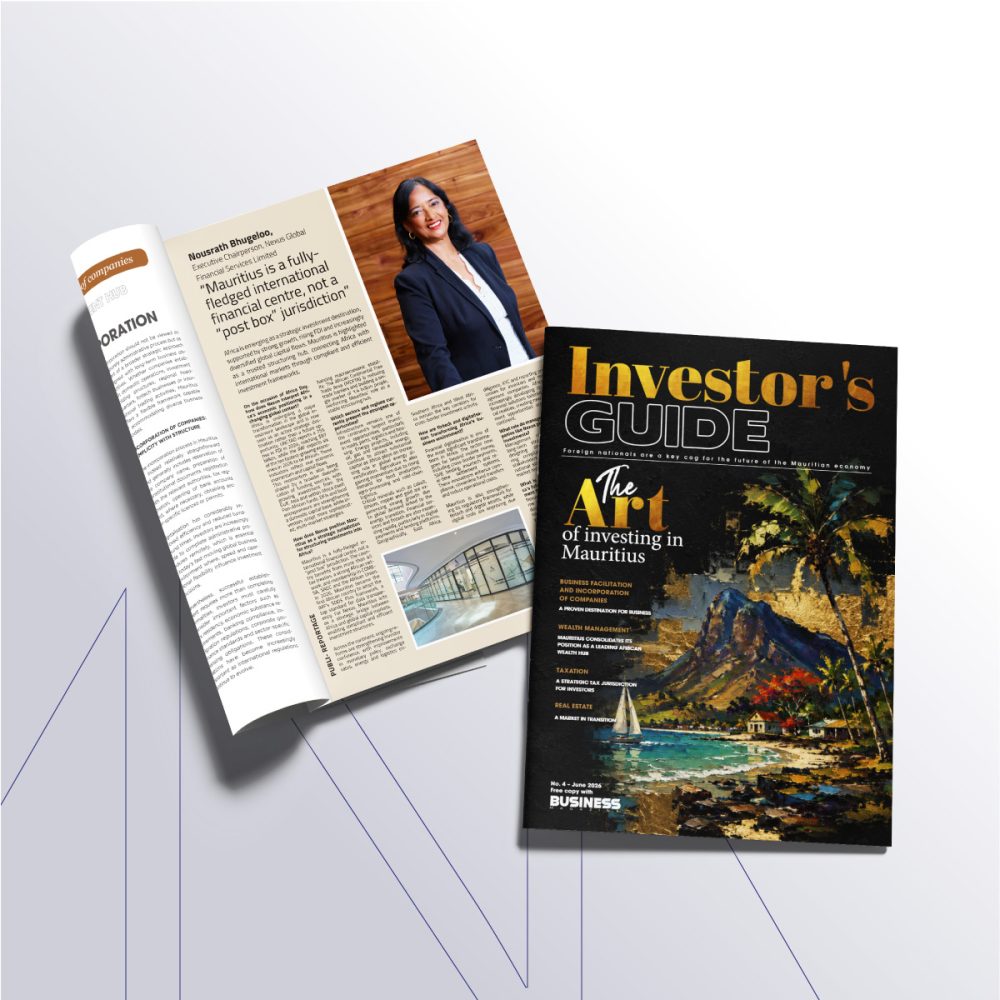
Featured in Business Magazine’s Investors Guide 2026:
Africa is emerging as a strategic investment destination, supported by strong growth, rising FDI and increasingly diversified global capital flows. Mauritius is highlighted as a trusted structuring hub, connecting Africa with international markets through compliant and efficient investment frameworks.
On the occasion of Africa Day, how does Nexus interpret Africa’s economic positioning in a changing global context?
Africa is undergoing a major transformation in the global investment landscape and is now seen as an active strategic destination rather than a future opportunity. UNCTAD reports a 75% rise in FDI in 2024, reaching $97 billion, while the IMF expects six of the ten fastest-growing economies in 2026 to be African. These indicators reflect real economic momentum and capital flows.
This momentum is also being shaped by a broader diversification of funding sources, with growing investment from the Gulf, Asia and within Africa itself. Pan-African funds, DFIs and local entrepreneurs are strengthening a domestic capital base, while investors adopt more sophisticated, multi-market strategies.
How does Nexus position Mauritius as a strategic jurisdiction for structuring investments into Africa?
Mauritius is a fully-fledged international financial centre, not a “post box” jurisdiction. The country benefits from more than 45 tax treaties, a strong African network, and membership in COMESA, SADC and the African Union. In 2026, Mauritius became the first African country to adopt the IMF’s SDDS Plus framework, a top standard for data transparency. For Nexus, Mauritius acts as a strategic bridge between Africa and global capital markets, enabling compliant and efficient investment structures.
Across the continent, ongoing reforms are strengthening investor confidence, with improvements in monetary policy, exchange rates, energy and logistics enhancing macroeconomic stability. The African Continental Free Trade Area (AfCFTA) is reducing trade barriers and building a single market of 1.4 billion people, reinforcing Mauritius’ role as a stable structuring hub.
Which sectors and regions currently present the strongest opportunities?
Infrastructure remains one of the continent’s largest investment opportunities, particularly in roads, ports, logistics and housing. Energy projects, including oil, gas and renewable energy, continue to attract substantial capital as Africa plays an increasing role in global energy diversification. Agriculture is also gaining momentum due to rising demand for food production, agro-processing and cold-chain logistics.
Critical minerals such as cobalt, lithium, copper and gold are experiencing strong growth due to global demand linked to the energy transition. Financial services and fintech are also expanding rapidly, particularly in digital payments and lending platforms. Geographically, East Africa,
Southern Africa and West Africa remain the key corridors for cross-border investment activity.
How are fintech and digitalisation transforming Africa’s business environment?
Financial digitalisation is one of the most significant transformations in Africa. The sector now goes far beyond mobile money, including cross-border payments, SME lending, insurtech and real-time settlement systems. These innovations enhance compliance, streamline fund transfers and reduce operational costs. Mauritius is also strengthening its regulatory framework for fintech and digital assets, while digital tools are improving due diligence, KYC and reporting processes for investors and management companies. Africa is increasingly developing its own financial solutions tailored to local realities, creating new investment opportunities across the continent.
What role do management companies like Nexus play in African investments?
Management companies are long-term strategic partners, designing structures, ensuring compliance, coordinating stakeholders and bridging international standards with African market realities.
What is Nexus’ vision for Africa’s future role in global investment flows?
Nexus believes Africa will become one of the world’s leading destinations for capital over the next decade. The continent’s young population, rapid urbanisation, growing middle class and strategic natural resources are strengthening its global importance. While challenges such as sovereign debt and governance issues remain, Nexus considers that the gap between perceptions of Africa and the realities on the ground is narrowing rapidly. According to the company, investors who adopt a long-term approach and use trusted jurisdictions and partners will be best positioned to benefit from Africa’s transformation.